
RAND WATCH: Continued resilience
As one of the most liquid currencies in the world, South African importers and exporters keep a close eye on the Rand. Despite a volatile geopolitical environment, the Rand has continued to display remarkable resilience despite a weak macro-economic environment and global tensions.
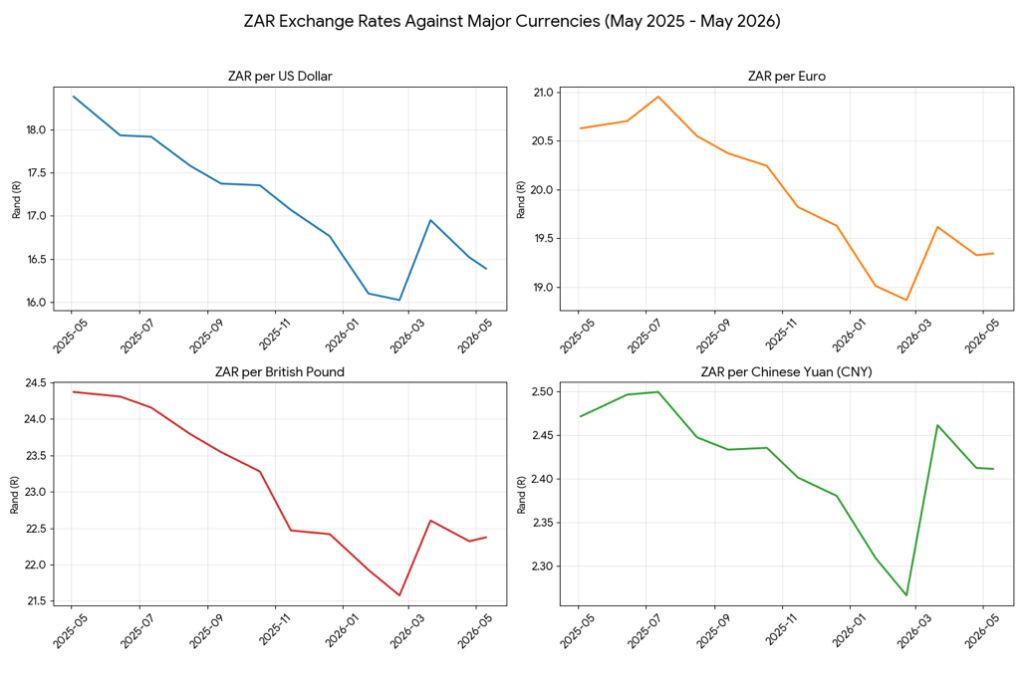
The below graph tells an interesting story as the relative strength of the Rand is displayed against the US Dollar, Euro, British Pound and Yuan (CNY).
The “Rand Peak” seen in February 2026 (as noted in the chart) coincided with a period of peak optimism regarding local structural reforms and a temporary stabilization in energy supply. However, the subsequent “sawtooth” pattern in March and April 2026 suggests that the market remains sensitive to global risk appetite and commodity price fluctuations.
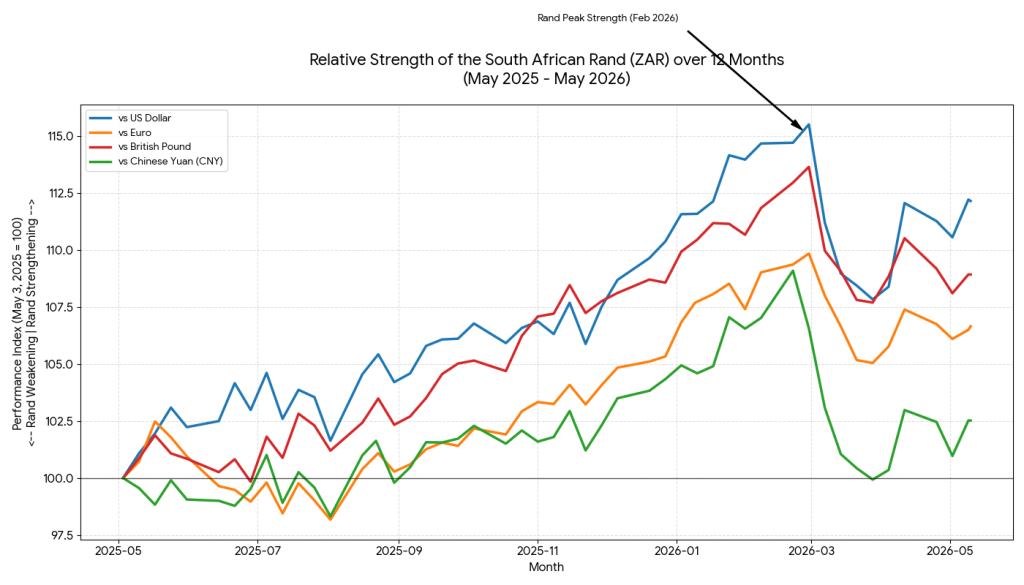
The Rand lost some ground in February as the conflict between the US and Iran ratcheted up. After an initial sell-off, the currency has trended stronger.
Foreign Flows: The “Wait and See” Exodus
The most critical factor for the Rand’s outlook over the next 14 days is the behaviour of foreign portfolio investors. The trend in the bond and equity markets has become the primary “canary in the coal mine.”
- The Yield Curve Friction
In the last two weeks, we have seen a continued net selling of South African government bonds by non-residents. While the volume of selling has decreased since the March 2026 “volatility spike,” the flows remain negative. This suggests that while global funds aren’t panicking, they are actively “trimming risk.”
2. The Liquidity Trap
South Africa’s highly liquid capital markets are currently a double-edged sword. Because it is so easy to exit the ZAR market compared to other emerging markets, the Rand is often the first currency sold when global geopolitical tensions rise. We saw this clearly in the first week of May, as friction in the Gulf prompted a broad-based move out of “high-beta” emerging market assets.
3. Dividend Repatriation Season
We are also entering the seasonal period where large multinationals listed on the JSE begin repatriating dividends. This historically creates a natural headwind for the Rand as local currency is sold for foreign exchange, potentially exerting pressure if not offset by commodity inflows.
Strategic Outlook: The May 28 Pivot
The immediate fate of the Rand rests on the SARB Monetary Policy Committee (MPC) decision on May 28, 2026.
- The Bull Case: If the SARB delivers a 25bps “insurance” hike to protect against oil-driven inflation, the carry-trade appeal of the Rand will remain intact, likely keeping the currency in the R18.40 – R18.70 range against the Dollar.
- The Bear Case: If the Reserve Bank holds rates while inflation expectations rise, foreign selling in the bond market could accelerate, pushing the Rand into a test of the R19.20 resistance level.
The SA Trade Desk verdict on the short-term outlook for the Rand:
For exporters, the current window offers a high-value opportunity to lock in forward cover. For importers, the “fragile recovery” seen in the chart suggests that volatility is the only certainty. We recommend a cautious stance until the foreign flow data stabilizes post-MPC.
Need to make smarter foreign exchange decisions?
Almost 80% of South African importers and exporters do not take professional advice when it comes to managing their foreign exchange risk. This can have a materially impact on profitability.
The SA Trade Desk has partnered with Verto to help local entrepreneurs make smarter business decisions.
By leveraging Verto, businesses can:
- Streamline payments across multiple countries and currencies
- Reduce operational complexity with an integrated platform for FX and cross-border transactions
- Enhance financial security and compliance with industry-standard controls
- Gain visibility and control over international cash flow
- Access strategic insights to optimize global operations
Find out more here.