

South African stocks face an uneven outlook as the gold rally loses steam
Author: Khuleko Siwele, The SA Trade Desk
South African equities are facing a more challenging outlook after a stellar 2025, with the retreat in precious metals prices exposing the risks of a market rally that was heavily concentrated in gold and platinum miners, according to Rand Swiss portfolio manager Gary Booysen.
Although the Johannesburg Stock Exchange’s headline performance may suggest resilience, the underlying picture is less encouraging. South African equities are down about 6% in total this year, Booysen said in a Global Market Outlook presentation on Thursday.
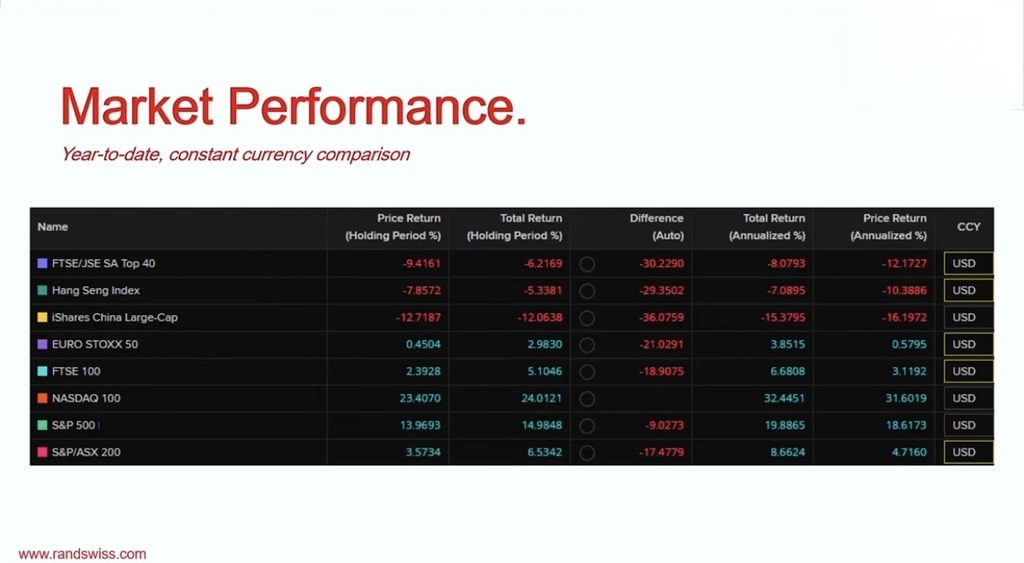
The divergence highlights the importance of looking beyond headline index performance to understand which companies are driving returns and where opportunities may emerge.
South African equities surged in 2025 as gold and other precious metals rallied, benefiting mining companies with significant operating leverage. As commodity prices increased while costs remained relatively stable, miners such as Harmony Gold, Gold Fields and AngloGold Ashanti, alongside platinum producers, generated substantial gains for shareholders.
However, the subsequent pullback in precious metals prices has placed pressure on the mining sector, exposing the extent to which the local market’s performance is supported by a relatively narrow group of stocks.
Booysen said this concentration also helps explain the contrasting fortunes of active investment managers. Managers who were underweight gold miners struggled to keep pace with the market during last year’s rally but have benefited from their relatively limited exposure as the sector has come under pressure this year.
“Different times create different things, and you need to just be cognisant of what you’re buying underneath it,” he said.
For investors, the shifting market environment reinforces the importance of stock selection, with opportunities increasingly dependent on individual companies’ fundamentals rather than broad market movements.
US: AI rally masks broader market weakness
Booysen warned that the strength of major US equity indices is concealing significant weakness across the broader market, as gains in artificial intelligence-related stocks have offset declines elsewhere.
He said the investment trade has increasingly centred on the Nasdaq and on companies benefiting from AI infrastructure spending, leaving other sectors and businesses under pressure.
According to figures cited by Booysen, 83% of S&P 500 constituents were trading more than 10% below their highs, while 42% had fallen more than 20% from their peaks. He argued that the scale of these declines points to a deeper correction beneath the headline index performance.
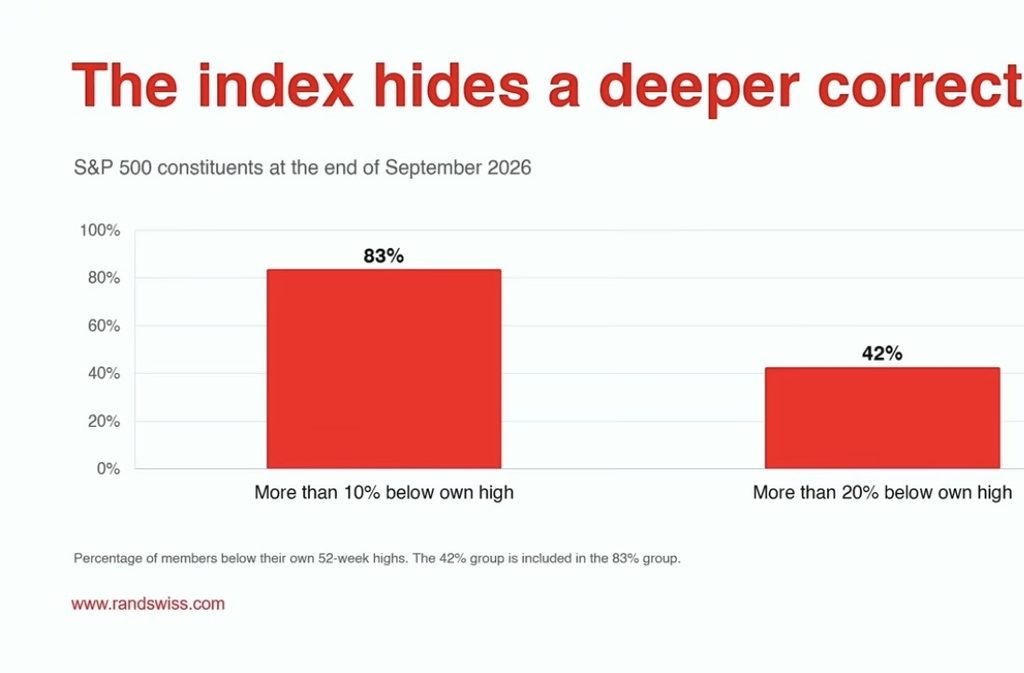
Booysen said AI is transforming businesses, and investors should maintain exposure to the technology but warned that companies could face sharp share-price declines if they fail to meet the high growth expectations already reflected in their valuations.
Even companies that continue to expand could disappoint investors if their earnings fall short of ambitious targets, potentially triggering a reassessment of valuations across the sector.
Another risk is intensifying competition. Booysen said the pace of innovation remains a critical competitive advantage for AI companies, but the possibility of rivals offering comparable services at lower prices could erode profitability.
He compared the potential outcome to the streaming industry, where competition between platforms has constrained pricing power.
For investors, he advocated conducting thorough research, prioritising quality businesses, and carefully assessing valuations rather than buying into the AI trade indiscriminately.
He also sees potential opportunities in companies that have been overlooked as capital has flowed into technology stocks. Financials and healthcare are among the sectors he considers attractive, with rising interest rates potentially supporting financial companies and ageing populations underpinning long-term demand for healthcare.
China: Weak performance points to a difficult year
China’s equity market is also struggling, with Booysen warning that the country is on course for a negative year after a disappointing performance through mid-October.
Chinese equities had delivered a total return of about -5% year to date, according to figures cited by Booysen, although he described the outlook as weak and said the large-cap index had performed even worse.
The subdued performance comes amid a global investment environment in which returns have been concentrated in a narrow group of AI-related businesses, leaving several major markets struggling to generate meaningful gains.
For investors assessing opportunities outside the US, Booysen said the focus should remain on identifying individual companies with attractive valuations and sound fundamentals, rather than assuming that weakness in an entire market automatically creates a buying opportunity.
Europe and other markets: Selectivity remains key
Beyond the US and China, Booysen sees opportunities in selected international companies but remains cautious about investing in broad European equity indices.
He pointed to the valuation appeal of some European businesses, including luxury goods group LVMH, which Rand Swiss had bought after its share price declined substantially. However, he cautioned that low valuations alone are insufficient when earnings growth remains weak.
He also cited regulatory complexity, fragmented national markets and differences in business environments across Europe as potential obstacles to corporate growth and shareholder returns.
Rather than buying the broader market, he favours identifying individual companies that can deliver attractive long-term performance.
Booysen also sees potential opportunities emerging in Latin America, although he indicated that investors should assess specific markets and businesses before committing capital.
Ultimately, he said the current environment requires investors to look beyond headline index returns and consider the underlying companies, valuations, and risks that shape performance.
For South African investors, the retreat in precious metals offers a reminder that a strong market rally can obscure concentration risks. As leadership shifts across sectors and regions, the ability to distinguish quality businesses from expensive market trends could prove increasingly important.