

A joint growth and resilience agenda for Africa and Europe could double bilateral trade to $1 trillion over the next decade
As the global economy undergoes a fundamental shift toward a multipolar landscape, a recent report from Boston Consulting Group (BCG) has highlighted the strategic need to revitalise the Africa-Europe corridor. The report, titled ‘Strengthening the Africa-Europe Corridor: Strategic Imperative in a Multipolar World,’ reveals that deliberate and well-orchestrated value chain integration could double bilateral trade from $545 billion today to $1 trillion over the next decade. A joint resilience and growth agenda of this nature would both accelerate Africa’s industrialisation while strengthening Europe’s competitiveness.
Africa and Europe are long-standing partners with deep economic and cultural ties, underpinned by geographic proximity and complementary socio-economic dynamics. However, the report highlights that the corridor has lost momentum. While Europe remains Africa’s leading partner across all major flows (trade, investment, finance, and mobility) the economic corridor has seen trade and investment grow more slowly than global averages over the last two decades.
The report warns that, at the same time, evolving trade patterns and technological concentration are now reshaping both continents’ global positioning. Increasing trade deficits and limited value capture in the global digital & AI economy, highlight significant white space for Africa and Europe to deepen bilateral collaboration and jointly scale local production. In addition to their shared challenges, complementary strengths make both continents “objective allies”: Africa has a young, rapidly urbanising workforce and abundant natural resources, while Europe offers high-end industrial capabilities, capital, and technological expertise.
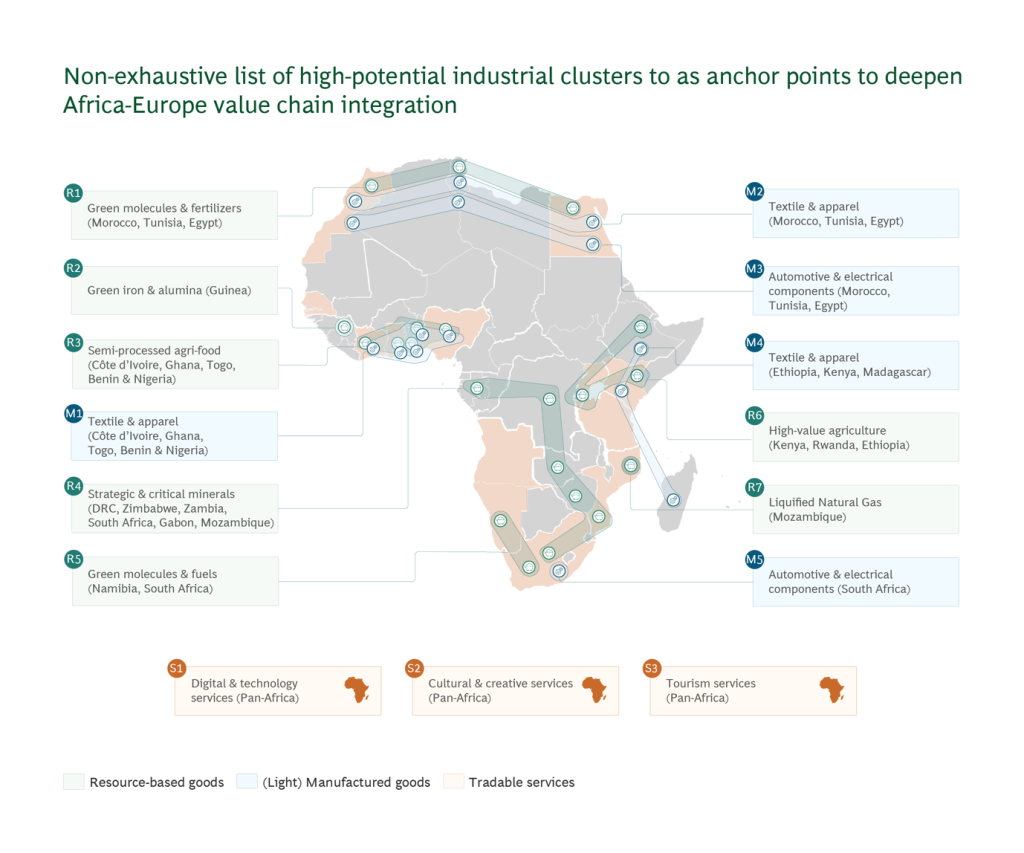
Realising this opportunity will require focusing on a select set of high-potential industrial clusters where Africa has clear structural strengths and Europe has strong strategic interests. BCG has proposed a non-exhaustive set of 15 priority industrial clusters with high potential to deepen value chain integration, spanning resource-based goods, light manufacturing, and tradable services:
- Moving African activities down the value chain, from upstream resource extraction to midstream processing, such as producing green molecules and fertilisers in North Africa or battery-grade metals in Central and Southern Africa, as well as developing agro-processing in several parts of the continent
- Nearshoring of (semi-)processed goods for European value chains, such as in the automotive and textile sectors.
- Scaling tradable services across the digital, tourism, and cultural and creative industries.
The report highlights two illustrative case studies where deepened value chain integration could create greater value for both continents:
- The DRC-Zambia Copperbelt: whilst Zambia and DRC hold 70-75% of global cobalt as well as 15-17% of copper production, Chinese companies dominate midstream and downstream of the cleantech industry. Europe could support Zambia and the DRC in their ambition to capture greater midstream value, while securing supply for its own emerging cleantech sector. This region is vital to Europe’s green transition. The value of this corridor could scale from $2 billion to $6 billion over the next decade.
- The West Africa Cashew industry: while West Africa dominates global cashew nut production; it exports 70% unprocessed to mostly Asian markets. Vietnam has large processing capacity despite limited domestic production and is responsible for 70% of Europe’s cashew imports. Integrating the Africa-Europe cashew value chain corridor more directly, could make it grow from $220 million today to $500-800 million over the next decade.
Capturing this $1 trillion opportunity requires immediate, coordinated action to address structural constraints such as reliable power, logistics efficiency, trade barriers, offtake agreements to catalyse investments in new value chains, as well as financial guarantees mechanisms to mobilize private capital.
“Over the past year, it has become increasingly clear that Africa and Europe are not just economic partners, but objective allies in a fragmented world. Both now urgently need to strengthen their industrial and technological competitiveness. Their complementarity is structural. Shifting from trade to co-production offers a rare win-win: sustainable growth for Africa and strategic resilience for Europe.” says Patrick Dupoux, BCG Managing Director and Senior Partner.
Badr Choufari, BCG Managing Director and Partner, adds: “What will determine success in the long run, is not ambition alone, but rather execution. Morocco’s industrial transformation over the last two decades illustrates how deliberate industrial policy and interventions can support integration into European markets. When interventions in infrastructure, skills and trade are well-sequenced, the economic uplift for both Africa and Europe could be substantial.”
The opportunity exists for Europe and Africa to create a genuine win-win outcome through joint value chain integration in selected sectors and geographies. Seizing this opportunity will require coordinated action from governments, development finance institutions, and companies, particularly as the window to strengthen this partnership evolves.
The full report is available for download.