
Tug-of-war Rand displays resilience in first quarter of 2026
Where will the Rand head over the next quarter?
As an importer or exporter in South African, this is a question which is occupying the minds of many entrepreneurs and management teams.
Despite recent geopolitical events, data for the first quarter suggests that the Rand is holding its own – something which is important if we believe that the currency is a measure of confidence in the South African economy.
Rand is displaying surprising strength
Heading into 2026, the South African economy was poised for a period of growth. Interest rates were falling, inflation was benign and confidence was returning to Africa’s largest economy.
This was disrupted by events in the Middle-East which has seen interest rate expectations reverse and inflation spiking on the back of oil price increases and supply chain disruptions.
As one of the world’s most liquid emerging market currencies, the Rand is susceptible to sharp movements.
We have mapped the Rand against a variety of different currencies, over the first four months of 2026 and it showcases a currency which is proving stable after the initial shocks wore off.
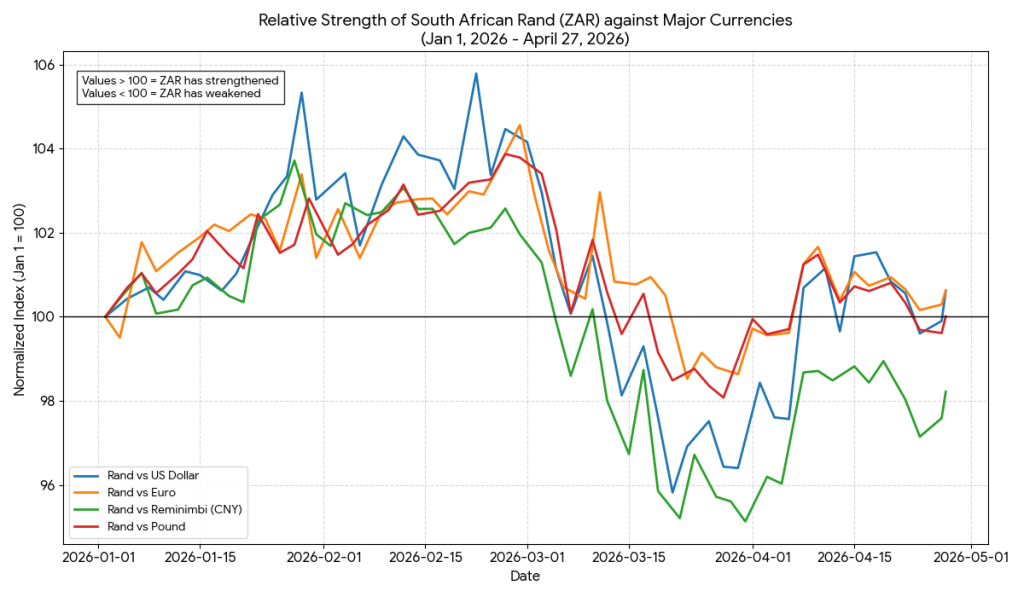
Analysis of the Data (Jan – April 2026):
- Overall Trend: The Rand saw a period of strength in February, peaking around late February, before experiencing a significant dip in mid-March. Since then, it has been on a recovery path.
- Best Performer: As of late April, the Rand has shown the most resilience against the US Dollar, currently sitting slightly above its January 1st starting point ().
- Relative Weakness: The Rand has remained relatively flat or slightly weaker against the Chinese Renminbi (CNY) compared to its January opening, currently down about from its peak performance in February.
- Volatility Spike: You can see a synchronized “V-shaped” recovery starting in mid-March, which likely corresponds to specific macro-economic events or changes in South African interest rate expectations during that period.
Spot rates at time of writing:
USD/ZAR: Started at ~16.58; currently ~16.48 (Rand strengthened slightly).
EUR/ZAR: Started at ~19.48; currently ~19.36 (Rand strengthened slightly).
GBP/ZAR: Started at ~22.34; currently ~22.34 (Rand is almost exactly where it started).
CNY/ZAR: Started at ~2.37; currently ~2.41 (Rand weakened slightly).
Rand facing complex tug-of-war
The current trajectory of the South African Rand is best described as a complex geopolitical tug-of-war, where domestic fundamental improvements are being pitted against a volatile global “risk-off” environment. On one side of the rope, the Rand is anchored by a significantly improved sovereign profile following its 2025 rating upgrade and successful exit from the FATF grey list. This domestic momentum is further bolstered by record-high prices in safe-haven commodities like Gold and Platinum. Goldman Sachs has highlighted this “commodity tailwind” as a key support pillar, suggesting that South Africa’s terms of trade remain a potent defence against a complete currency blowout. For investors, this creates a “bullish” floor that keeps the Rand attractive relative to other emerging market peers who lack a similar resource-driven buffer.
However, the opposing force in this struggle is a surge in global risk aversion driven by escalating tensions in the Middle East. Investec has been particularly vocal about this “defensive” pivot, noting that the Rand has recently behaved like a high-risk asset, shedding over 3.5% of its value against the US Dollar as investors seek the safety of the Greenback. This pressure is compounded by JP Morgan’s analysis of the “macro uncertainty” premium; with oil prices hovering near $100/bbl, the specter of imported inflation threatens to erode the gains of the Rand’s earlier 2026 rally.
Consequently, the currency remains trapped in a volatile range, stuck between the structural optimism of local reform and the reactionary fear of global supply-side shocks. This leaves brokers split, with forecasts oscillating between a return to R15.00 levels if tensions ease, or a slide toward R17.30 if the war premium intensifies.
How can South African businesses better manage their foreign exchange risks?
It is estimated that between 70 and 80% of South African businesses employ no foreign exchange hedging or management strategies when planning their import and export strategies.
This leaves them completely at the mercy of short-term currency movements and spot rates.
The South Africa Trade Desk has partnered with global firm Verto to provide a solution to our stakeholders to better manage their foreign exchange and currency risks. This allows importers and exporters to streamline payments across multiple countries and currencies and reduce operational complexity with an integrated platform for foreign and cross-border transactions.
If you would like to find out more, please click HERE.