
Morocco passes South Africa in investability ranking
Author: Khuleko Siwele, The SA Trade Desk
Growth momentum has propelled Morocco past South Africa in the ranking of Africa’s most investable countries, according to Rand Merchant Bank.
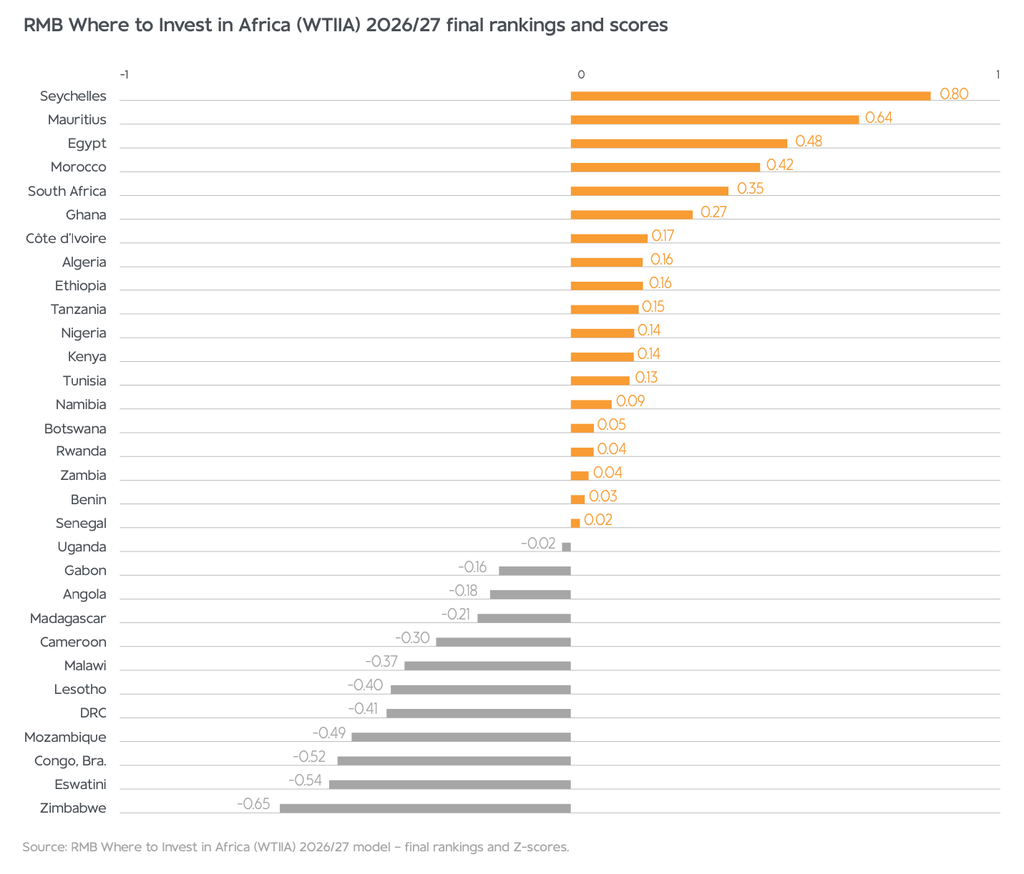
According to the 2026/27 RMB Where to Invest in Africa report, “industrialisation, export diversification, infrastructure investment and macroeconomic stability have strengthened Morocco’s position”. Morocco has moved to fourth, pushing South Africa to fifth among the 31 countries ranked.
South Africa remains a significant investment market, supported by deep financial markets, improving reform delivery and substantial shock-absorbing capacity, but slower growth continues to place pressure on its ranking.
“Africa’s strongest investment markets are increasingly those that combine growth with credible policy, stronger institutions and greater resilience to shocks. These qualities are becoming more important as global uncertainty tests the durability of investment
opportunities,” says Isaah Mhlanga, Chief Economist at RMB.
Since the report’s inception, Côte d’Ivoire has risen from 16th to 7th, demonstrating one of the strongest sustained growth stories in the report. Economic growth, disciplined programme implementation, infrastructure development and expanding energy production have steadily improved its investment profile.
Nigeria has seen a decline, moving from ninth to 18th and now sitting at 11th. Its recovery shows improving confidence in the long-term without understating the costs and execution risks involved. Senegal moved from 19th to 18th place in the recent report, down from eighth, as sovereign rating downgrades and uncertainty around IMF engagement have weakened investor confidence.
Seychelles, Mauritius and Egypt have remained in the top three since the 2024 edition of Where To Invest in Africa.
Beyond asking which markets are attractive, RMB has introduced a resilience and vulnerability matrix that examines policies, institutions, and buffers that help an economy withstand and recover from shocks.
According to the report, South Africa, Algeria and Rwanda emerge as more resilient and less vulnerable, with more economically complex environments. South Africa’s deep and liquid financial markets, diversified output, and substantial services sector give it meaningful shock-absorbing capacity.
Rwanda’s standing reflects institutional quality, policy credibility and disciplined economic management rather than scale. Algeria’s profile is supported by the buffers created by hydrocarbon revenues, while its longer-term resilience depends on continued diversification.
“In a time of global economic uncertainty, Africa’s investment story shows that growth is increasingly being supported by reforms rather than commodity cycles alone,” says Mhlanga.