
Private power projects continue surge in South Africa
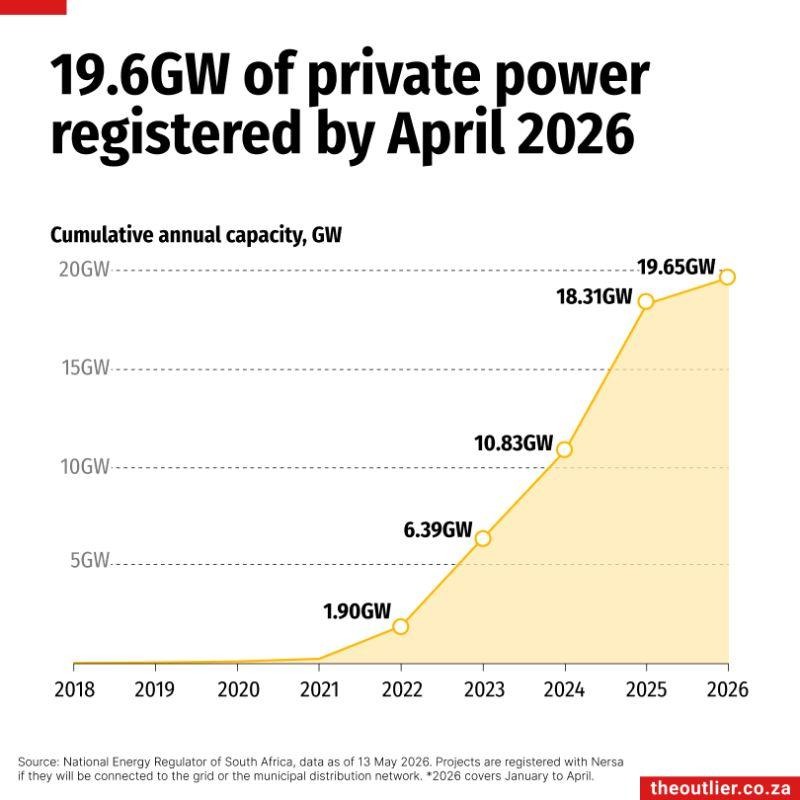
Energy security has long been identified as the single greatest bottleneck to South Africa’s economic growth, export potential, and industrial renewal. However, a significant revolution is taking place on the national grid. Private power projects registered with South Africa’s National Energy Regulator (Nersa) are now rapidly closing in on a monumental 20GW milestone, signalling a major structural shift that promises to fundamentally stabilise the country’s manufacturing and trade corridors.
According to recent Nersa data collated by data journalism group “The Outlier” the momentum behind decentralised generation has accelerated sharply. In the first four months of 2026 alone, 132 new private generation projects were registered, injecting a combined capacity of 1.34GWinto the pipeline
Subscribe to the free Outlier Renew newsletter for more renewable data and stories here.
The Power Surge: 2026’s Utility-Scale Pioneers
This wave of deployment is increasingly defined by massive, utility-scale projects designed to wheel power across provinces to heavy industries, mines, and logistics hubs. So far this year, six massive projects boasting capacities of 100MW or more have successfully registered with the regulator:
| Project Name | Technology | Capacity | Province |
|---|---|---|---|
| Lengana Solar PV | Solar PV | 250MW | Free State |
| Mulilo Kuruman Wind Power (Phase 2) | Wind | 240MW | Northern Cape |
| FS Stinkputs Wind | Wind | 240MW | Northern Cape |
| Nyala Solar Power Plant | Solar PV | 240MW | Free State |
| Volta PV | Solar PV | 150MW | Free State |
| Lerato Solar Power Plant | Solar PV | 120MW | North West |
Export to Sheets
The geographical distribution of these projects underscores a strategic economic realigning. The Free State, Northern Cape, and North West are rapidly morphing into the green engine rooms of South Africa, utilising vast tracts of land and excellent solar and wind yields to feed the national grid.
Rebuilding South Africa’s Industrial Foundations
For the trade, manufacturing, and logistics sectors, this private generation surge is not merely an environmental victory; it is an economic lifeline.
1. Restoring Manufacturing Competitiveness
South Africa’s factory floors have historically been hamstrung by energy volatility. Industries ranging from automotive assembly to steel manufacturing require continuous, predictable power. The introduction of 20GW of highly responsive, decentralised private capacity allows industrial operations to de-risk their production lines. By mitigating grid instability, local manufacturers can stabilise input costs, run multiple shifts without disruption, and fearlessly commit to strict export deadlines in global supply chains.
2. Powering Modern Logistics and Ports
A stable industrial economy is entirely co-dependent on efficient logistics. As South Africa concurrently aggressively pushes to reform its rail and port infrastructure, the integration of private power is vital. Cold storage facilities at crucial maritime export hubs, automated transshipment depots, and electrified freight lines all demand absolute energy resilience. The current private energy surge guarantees that the vital infrastructure moving South Africa’s trade wealth from factory to port remains uninterrupted.
The Trade Desk View: Unlocking Foreign Direct Investment (FDI)
Global capital is inherently risk-averse. For international manufacturers, assembly plants, and data centre operators looking at the African continent, an unreliable energy grid serves as an immediate disqualifier.
The data from Nersa proves that South Africa’s regulatory environment has successfully unburdened the private sector, transforming the energy deficit into a massive investment destination in its own right. As these multibillion-rand projects move from registration to active generation, they send an unmistakable signal to foreign markets: South Africa is systematically addressing its infrastructure challenges.
By combining private logistics reform with an unprecedented private energy boom, South Africa is rebuilding the structural foundations required to regain its status as the uncontested industrial hub of Sub-Saharan Africa. The surge to 20GW is proof that when given the space, private capital stands ready to power South Africa’s trade future.