

Resilient Global Trade could grow 2.5% annually through 2034 despite rising geopolitical fragmentation
Global trade could prove to be more resilient than many expected in the face of economic nationalism and increasing tariffs, under a new scenario analysis from Boston Consulting Group (BCG). One scenario gaining momentum shows world goods trade growing 2.5% annually through the next decade, slightly faster than global GDP, expanding from around $23 trillion annually in 2024 to nearly $30 trillion in 2034. The trade lanes those goods travel, however, would be dramatically reshaped.
These are among the findings in the latest report from BCG’s Center for Geopolitics, Trade in Transition: How to Prepare for a Patchwork World Order, published today.
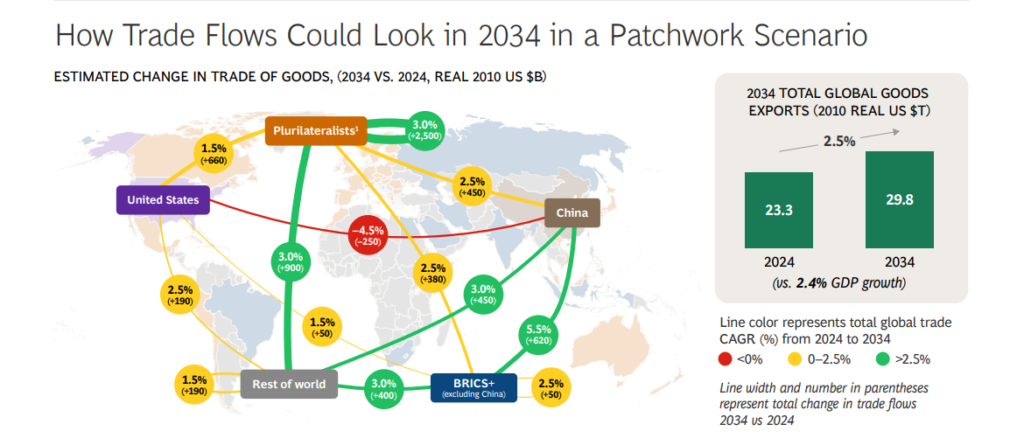
Given the immense difficulty in predicting the contours of the dynamic global trade landscape a decade from now, BCG has identified four possible scenarios. The greatest momentum is behind a more moderate scenario. A “multi-nodal trade patchwork,” in which trade flows gravitate around four main nodes employing distinct approaches. These nodes are the US, China, and two informal groupings of economies BCG calls the “Plurilateralists” and “BRICS+ excluding China.”
“The future of global trade won’t be defined by a single set of rules, but by a patchwork of relationships and regional priorities,” said Aparna Bharadwaj, managing director and senior partner, Global Leader of BCG’s Global Advantage Practice, and a co-author of the report. “For businesses, this isn’t just a policy shift. It’s a strategic inflection point. Our modeling shows that even amid rising fragmentation, trade remains on a clear growth trajectory, and the advantage will go to those who move early to adapt and lead in this evolving landscape.”
Under this multi-nodal trade patchwork scenario:
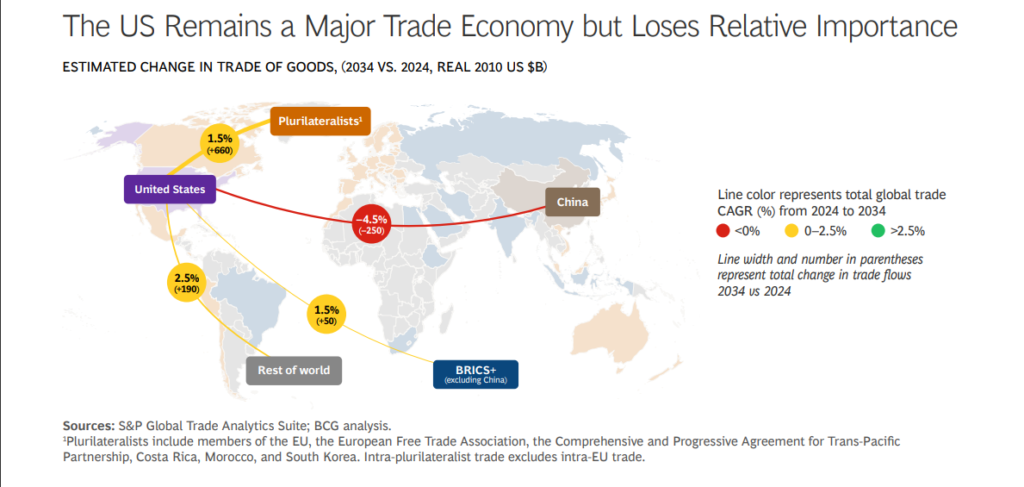
- The US share of global goods trade is projected to decline as it maintains its America First focus, which favors domestic production over imports.
- This projected decline is due to higher tariffs and other barriers. The share of US imports covered by tariffs has grown from 13% to 61% since January 2025.
- Notably, though, slower growth in trade does not necessarily mean slower GDP growth if there is a boost in consumption and domestic production.
- Two-way trade growth with the non-China BRICS+ nations is projected to grow by only 1.5% annually, as would US trade with the Plurilateralists.
- US-China trade would decline by 4.5%, continuing a downward trend observed over the last several years.
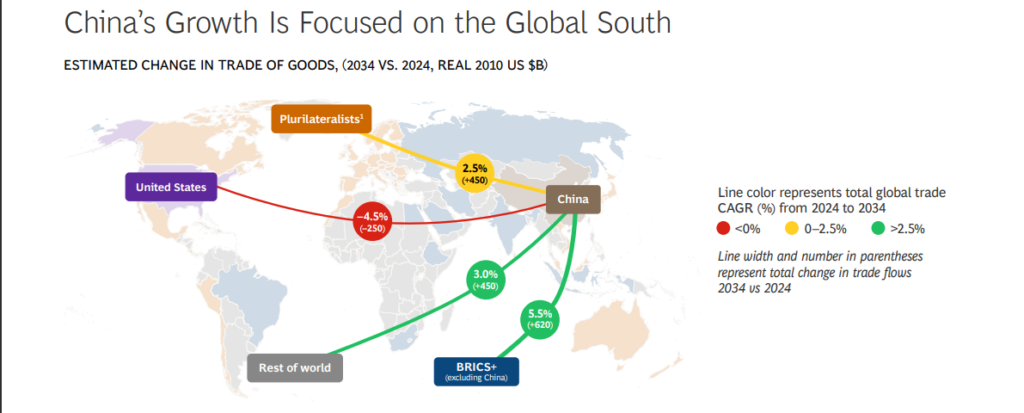
- China’s trade growth is projected to grow as it remains the largest trade partner with the Global South.
- China’s trade growth with the Global South would be driven by its growing need for energy, foods, and industrial inputs, as well as new markets for its finished goods.
- BCG predicts a particularly strong 5.5% CAGR for China over the next decade with other BRICS+ nations and 3% CAGR with the rest of the world.
- The Plurilateralists will see above-average trade growth among themselves and most of the Global South through 2034.
- This diverse set of both advanced and emerging economies remain committed to rules-based trade. While they do not constitute a formal bloc, each belongs to one or more plurilateral trade agreements (those among at least three nations).
- This group includes all EU members, the four European countries belonging to the European Free Trade Association, the original 11 CPTPP members (Australia, Brunei, Canada, Chile, Japan, Malaysia, Mexico, New Zealand, Peru, Singapore, and Vietnam) and the UK, South Korea, plus smaller free-trading economies such as Costa Rica and Morocco.
- The Plurilateralists could deepen relationships among themselves, with 3% CAGR through the coming decade, as they lower trade barriers and seek to diversify away from the US and China.
- Trade with BRICS+ economies will see 2.5% CAGR for the coming decade and 3% CAGR with the rest of the world.
- The BRICS+ nations excluding China will expand their trade relationships with the Global South as well as China.
- This grouping includes original BRICS members Brazil, Russia, India, and South Africa and nations that joined later, such as Egypt, Ethiopia, Indonesia, Iran, and the United Arab Emirates.
- BRICS+ countries have been taking steps to collaborate with each other on trade, which they see as a driver of growth. But their approach to trade differs, with some negotiating deals with other groupings and some not.
- BRICS+ nations excluding China could see 3% CAGR with the rest of the world and average trade growth among themselves.
- Nations outside these four nodes are grouped into the “Rest of the World” category.
- Most are Global South economies in Asia, Africa, the Middle East, and Latin America that seek strategic neutrality.
- These free agents, however, will become increasingly important in the future, both as markets and suppliers of goods and services.
BRICS+ nations excluding China face significant trade winds as they navigate steeper US tariffs of 27.5% while deepening commercial ties with China and the broader Global South. The findings project 3.3% annual growth through 2034, with trade linked to China accounting for 40% of this increase. What makes this trajectory particularly compelling is the infrastructure being built to accelerate intra-BRICS+ commerce.
Developments over the next few years will be shaped by trade enablement initiatives designed to unlock deeper intra-BRICS+ integration. Institutions like the BRICS New Development Bank and expanding non-USD local-currency payment rails are reducing financing and settlement frictions that have historically constrained South-South trade. Enhanced logistics connectivity, customs simplification and harmonization, and digital trade processes are providing practical enablers, while business-led initiatives such as the BRICS Business Council are gaining traction. As the bloc works to narrow its current $93 billion trade deficit with China, these mechanisms will be critical to unlocking comparative advantages in energy, metals, mining, and agribusiness, while India and Brazil continue scaling their manufacturing and higher-value production capabilities.
“Global trade isn’t retreating; it’s reorganising,” said Marc Gilbert, managing director & senior partner, Global Leader of the Center for Geopolitics, and a co-author of the report. “Leaders who embed geopolitics in capital and strategic decision-making will be best positioned to navigate the next decade of change to secure resilience as well as growth.”
Download the publication here.