
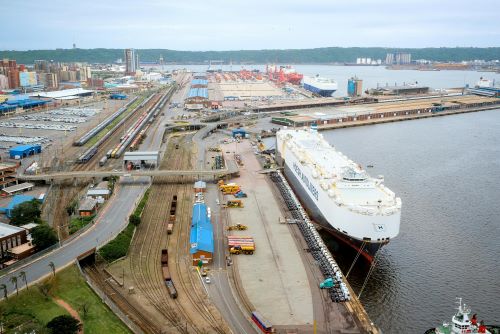
WATCH: ‘Can Capital Spark SA’s next Industrial Boom?’
How do we kick-start South Africa’s industrial economy in such a way that we become globally competitive in the face of changing trade relationships? Can we create an industrial boom which unlocks investment capital and creates hundreds of thousands of new jobs?
This is a question which policy-makers in South Africa have continued to grapple with as the country seeks to balance its developmental agenda with the rapid pace of technology and innovation.
These challenges are further compounded by the fact that there has been limited investment in infrastructure – including energy, water and logistics – which has increased the frictional cost of doing business in South Africa and made the country less competitive in global markets.
The Public Investment Corporation (PIC) is one of South Africa’s largest institutional investors and will be a key partner in major infrastructure projects in the years to come.
The PIC has recently released an insightful piece of research entitled: “Re-industrialising South Africa: Can institutional capital sparkSouth Africa’s next industrial boom?”
Authored as part of a contribution to the G20, the report is authored by:
- Mr Geoffrey Nölting (PIC)
- Dr Brian O’Callaghan (University of Oxford)
- Dr Kieran Brown (University of Oxford)
Drawing on insights from other Emerging Markets including Thailand, Indonesia and Brazil, the research looks at opportunities in key sectors including:
- Agro-Processing
- Mining beneficiation
- Automotive manufacturing
The report focuses on 3 investor areas, namely:
- Policy and infrastructure
- Finance architecture
- Market connectivity
Watch the report presentation for ideas on unlocking SA’s industrial boom potential:
Download the full report here.
A “compelling case for foreign investors”
One of the major challenges for the South African market is that the country has struggled to attract foreign investment capital. This has been a result of a combination of factors including low growth prospects, but also regulatory issues such as the “Grey-listing”.
Encouragingly, the report notes:
“The fundamentals of South Africa’s industrialisation opportunity are compelling. The country is both the entry point to Africa’s 1.4 billion-person market and it is itself a growing economy with a young, urbanising population. Challenges in infrastructure, energy, and logistics remain significant, but they are being addressed through reform initiatives such as Operation Vulindlela and increased private participation. The trajectory is one of a market correcting its bottlenecks, not succumbing to them.
For foreign investors, the opportunity is twofold: capture differentiated, risk-adjusted returns while catalysing South Africa’s industrial renewal. This alignment of profit and development —the essence of shared value — makes the case for mobilising institutional capital into the country’s industrialisation both urgent and attractive.”
What a country makes and exports matters for growth
In assessing market opportunities, the authors of the report believe that the country can position itself a strategic hub for manufacturing, logistics, and services connecting Africa, Europe and Asia.
While opportunities [and challenges] in the automotive sector are well documented, the report also points to market opportunities in other sectors.
South Africa is home to the continent’s most diversified agro-processing base spanning meat, fruit, beverages, sugar, wine, and dairy products. Success stories include our citrus sector as well as Macadamia Nuts and there has been significant growth in Ready-To-Eat meals and fruit juice markets.
On the mining and beneficiation front, South Africa is blessed with natural resources but has suffered from chronic under-investment – and associated challenges – in the exploration space. To support earlier stage investment, the PIC has recently announced the establishment of a R1.35bn fund to support earlier stage investment.
The report concludes that South Africa has real potential for an industrial boom:
While there is still a lot of work to do, the report does conclude on an upbeat note saying:
“South Africa’s industrialisation is not speculative — it is an execution challenge with clear upside. Institutional investors have the opportunity to achieve sustainable financial returns while driving transformative economic and social impact. By aligning priorities, deploying innovative financing structures, and leveraging existing reforms, South Africa can transition from incremental progress to sustained industrial growth. The roadmap is clear, the building blocks are in place, and the time for bold action is now.”