Author: Marc Ashton
One of South Africa’s most strategically important sectors continues to rebound according to recent data released by Statistics South Africa (StatsSA).
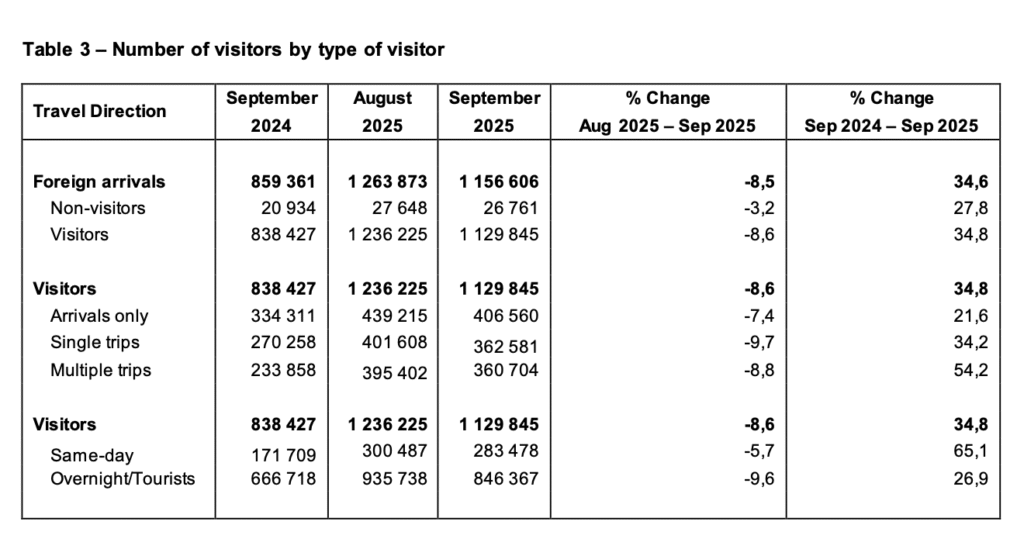
In September 2025, 2 988 099 travellers (arrivals, departures and transits) entered and exited South Africa. They comprised 777 281 (26,0%) South African residents and 2 210 818 (74,0%) foreign travellers. Foreign arrivals comprised 26 761 (2,3%) non-visitors and 1 129 845 (97,7%) visitors. Visitors consisted of 283 478 (25,1%) same-day visitors and 846 367 (74,9%) overnight visitors (tourists).
The tourism sector is a key contributor to the South African economy for a number of reasons. Firstly, it represents one of the easiest routes to grow the local economic pie through in-bound tourism spend – bringing in US dollars, Euros, Pound Sterling and other forms of hard currency.
Further to this, it allows for the creation of employment opportunities – including entry-level in the hospitality sector – while also stimulating economic activity outside of traditional urban metros.
South Africa is blessed with a number of high-quality attractions for both business and leisure tourists.
Where do South Africa’s tourists originate from?
Overseas tourists constituted 21,5% (181 802) of all tourists. United States of America (USA) (33 985), United Kingdom (UK) (25 513) and Germany (18 276) contributed 42,8% to overseas tourists. Tourists from Southern African Development Community (SADC) countries constituted 76,3% (645 745) of all tourists. Zimbabwe (183 975), Mozambique (176 139) and Lesotho (104 339) contributed 71,9% to SADC tourists. ‘Other’ African countries (non- SADC) tourists were 2,1% (17 676) of all tourists. Kenya (5 039), Ghana (4 039) and Nigeria (2 724) contributed 66,8% to ‘other’ African tourists.
The below table provides insights into the number of visitors by type year-on-year.
Where are South African tourists arriving from?
In September 2025, the distribution of overseas tourists was as follows: Europe, 94 470 (52,0%); North America, 40 289 (22,2%); Asia, 18 703 (10,3%); Australasia, 15 567 (8,6%); Central and South America, 8 506 (4,7%) and Middle East, 4 267 (2,3%
The below table provides insights into the year-on-year comparison of country of residence outside of Africa.

The African market – of growing relevance and will be boosted by AfCFTA
While US, European and Asian tourism markets are key drivers of the segment, the growing contribution and “share of wallet” from the rest of Africa cannot be ignored.
The below tables highlight contributions from SADC region members and then the rest of Africa:

Why do tourists come to South Africa?
South Africa is ideal location for blending business and leisure travel.
According to the September data, 97.1% of visitors came for holiday with other insight including:
- Within the overseas regions, Australasia, 99,4% (15 480) had the highest proportion of tourists who came for holiday, followed by North America, 98,8% (39 804); Central and South America, 98,5% (8 381); Europe, 97,8% (92 402); Middle East, 96,5% (4 118) and Asia, 93,4% (17 468).
- Asia, 5,1% (960) had the highest proportion of tourists who came to South Africa for business, followed by Middle East, 2,6% (109); Europe, 1,8% (1 701); Central and South America, 1,1% (93); North America, 1,1% (429) and Australasia, 0,5% (79).
Momentum is building for South African tourism
Due to its strategic contribution to South African GDP, there is a lot of interest in these tourism statistics.
What is important to recognise is that while momentum is building, South Africa still remains below pre COVID-19 tourism levels.
As the table below highlights, if South Africa gets back to these levels, an additional 200 000 – 235 000 visitors would arrive. Looking at industry data, we can assume that the average tourist will spend around R1600 per day and if we assume that each tourist spends an average of 8 days, that will translate into another R2.5bn in tourism spend – simply by getting back to pre-COVID19 levels.

These latest figures from Statistics South Africa point to a pleasing improvement in the tourism sector and we look forward to reporting further growth in the next quarter.