
The Digital Decline of the DTIC
At a time when South Africa’s trade policy – and its relationships with key trading partners – faced heightened uncertainty, why did the “store window” see its number of visitors halve over a 12-month period?
This is a question we have been asking ourselves as an advisory business over the past few months while conceptualising the launch of the SA Trade Desk property.
There is no doubt that discussions around trade have dominated headlines in 2025. The graphic below, shared by Codera Analytics, represents the South Africa Trade Uncertainty Index, which tracks words and phrases related to tariffs, supply chain disruptions, and other trade-related risks.
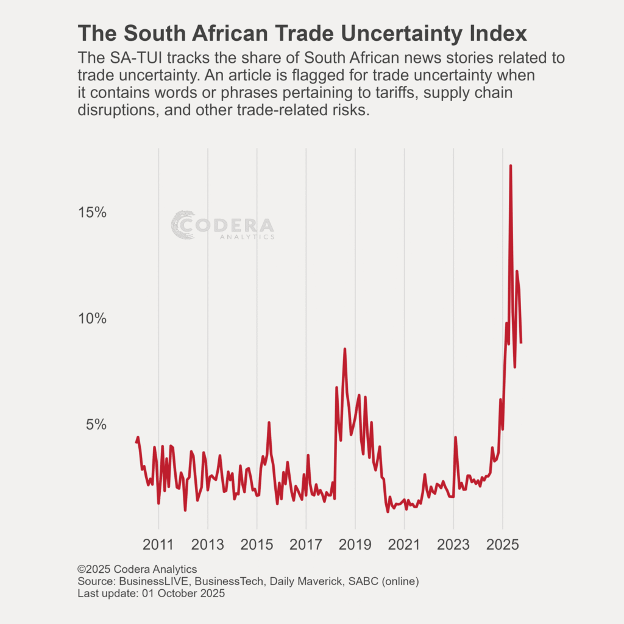
This period has also coincided with the expiration of the African Growth and Opportunity Act (AGOA) — an issue that has been highly topical, particularly for sectors such as agriculture, automotive, textiles, and manufacturing. These industries have long enjoyed preferential access to US markets under AGOA, a programme designed to drive economic growth and improve market access for African exporters.
At a time when trade delegations are shuttling around the world in an effort to woo new partners, one would expect that the website of the department responsible for educating the market about South African trade and trade policy would be experiencing a steady rise in organic traffic.
In addition, South Africa is hosting the B20, has established an Export Support Desk to assist exporters facing operational disruptions, and continues to see robust debate around the state of Broad-Based Black Economic Empowerment (B-BBEE).
Yet, when we look at the organic traffic to the Department of Trade, Industry and Competition (DTIC) website — the custodian of these key discussions — a worrying trend emerges.
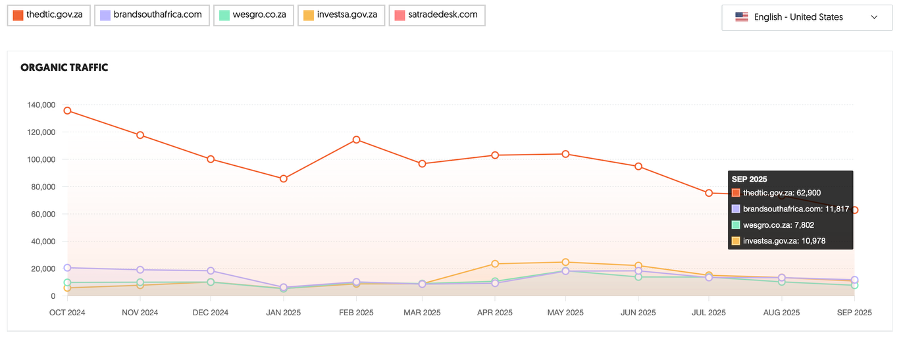
For the benefit of this exercise, we included comparative trends with the likes of BrandSouthAfrica.com, Wesgro.co.za and Investsa.Gov.za whose have similar mandates for driving the positioning of South Africa in the global business environment.
Caveat: The world of web traffic has changed dramatically in the past 12 months
We run a strategic advisory and communications business, so we have a solid understanding of the evolving landscape around website search traffic, domain authority rankings, and the impact of AI-generated extracts and snippets on browsing behaviour.
We also acknowledge that the way website traffic is measured will always be a contentious topic.
That said, it is fair to follow the trends — and if the trend is down by 54%, that represents a significant data point.
Coming off a lower base, the InvestSA platform achieved an 85% increase over the same period, providing useful context to this data.
Limited agility with digital assets
We would be remiss to discount the fact that the DTIC – as many of its fellow government department counterparts will attest – struggle with constraints around agility and their digital assets. A WordPress website can be put together in a relatively short space of time, but legacy infrastructure is harder to adapt.
In this challenge also lies an opportunity.
Fertile ground for Public-Private-Partnerships and nimble digital stakeholders
At a time when South Africa should be embracing the digital economy — and the rapid rollout of high-speed internet is connecting more of our citizens than ever before — we should not be seeing declines of this scale.
Historically, South African policymakers have favoured a highly centralised approach to stakeholder engagement and policy development.
Subpar economic growth over the past 15 to 20 years suggests that this approach is no longer fit for purpose in a rapidly evolving global digital economy. The data clearly shows that stakeholders are finding declining value in the DTIC’sdigital assets as a source of information or policy direction.
This is particularly relevant in a country where traditional business media outlets are struggling to sustain their business models.
We cannot rely solely on our national sports teams to keep South Africa front of mind — rather, we need collaborative digital platforms that can showcase our country to the rest of the world.
Our goal with the SA Trade Desk
As a private sector consulting firm, we do not see it as our purpose to replace the role that government should play in SA’s global trade direction and policy-making.
Rather, we have utilised some of our experience in content creation, to create a platform where we can amplify discussions, build meaningful debate, share thought-leadership from public and private sector role players and ultimately share opportunities.
On top of this, we want to support the activities of the Chambers of Commerce and Business as well as other developmental stakeholders working in the country. The more resources that can be brought to showcasing South Africa as a viable investment destination, the stronger our economy will become.
We can take this one step further by pointing to recent data from the South African Reserve Bank (SARB) which indicates that non-bank companies in South Africa are sitting on just under R2 trillion in cash resources. If we can unlock even a portion of this “dry-powder”, we can have a massive multiplier effect on the South African economy.
We look forward to engaging with you.
If you would like to discuss this opportunity, you can either reach out to me on LinkedIn or e-mail me on marc@decusatio.co.za
Marc Ashton is an award-winning financial journalist having previously worked for Fin24, been the editor of Finweek magazine and run Moneyweb prior to its de-listing from the JSE. Today he is the CEO of advisory business Decusatio – the owner of the SA Trade Desk project.